During the next couple of months, we will be begin discovering how the world functions around us as we "Discover Community." Using the project approach, this investigation will unfold in three phases, using timelines that flow with the class discussions and questions. This week, I have begun with Phase 1: Learning about our Experiences and Questions. Please take a moment to look on the wall by the door as I document our learning throughout this project.
Seabury School challenges gifted children in a community that cherishes each individual and fosters a love of learning, discovery and creativity.
Tuesday, September 30, 2014
Apples, Apples, Apples!
Last week, we conducted our first of many investigations that will take place this year. We are scientists during this time: we use tools such as magnifying glasses, tweezers and safety goggles (if someone can get a good hookup to some lab coats that would be amazing!). We spend time observing objects and documenting what we see and begin to formulate our questions and hypothesis' for experiments. We read from a variety of sources to gather research about our topic of investigation, and conclude with documenting our new learning. In addition, math, writing and art were integrated throughout.
During the next couple of months, we will be begin discovering how the world functions around us as we "Discover Community." Using the project approach, this investigation will unfold in three phases, using timelines that flow with the class discussions and questions. This week, I have begun with Phase 1: Learning about our Experiences and Questions. Please take a moment to look on the wall by the door as I document our learning throughout this project.
Friday, September 19, 2014
Introduction to STEM learning
This year, our Early Learning team is placing an emphasis on STEM learning. STEM stands for Science, Technology, Engineering and Math. These skills are to be integrated across the curriculum, not just taught in isolation. This comes so naturally when working with young children as they are still concrete learners and just beginning to connect with ideas and concepts they can't always see or feel or even experience. Although I will teach math in isolation at ability groups, skills such as measurement, computation and geometry are being used daily in their play and investigations. Their free choice time consists of open ended toys that bring out creativity, problem solving and critical thinking skills. The blocks, marble run, etc. are all incorporating math and science skills as they engineer their structure. They learn about physics and how things go together and balance as structures get taller. In the early learning program, we are not as concerned about the specific "topic," rather the skills necessary to be applied to learning anything new. The topics are explored based on class interests and emerging events.
We have had such a busy week getting settled into our routine, starting small groups for reading and math instruction, and being introduced to the scientific tools we will be using this year. Next week we will be doing experiments and observations with apples, and begin to discuss the change of seasons. This week we used our observation journals to draw detailed pictures like scientists. And of course, we had a fun morning with our bikes! We graphed how many wheels each child had on their bike, and a few Bumblebees took on the challenge of totaling all the wheels, and used manipulatives to build numbers and act out number stories.
| These students are incorporating symmetry and comparing lengths |
| These rods are used for a variety of math skills. They can be used for fractions, number decomposition, and measuring. |
We have had such a busy week getting settled into our routine, starting small groups for reading and math instruction, and being introduced to the scientific tools we will be using this year. Next week we will be doing experiments and observations with apples, and begin to discuss the change of seasons. This week we used our observation journals to draw detailed pictures like scientists. And of course, we had a fun morning with our bikes! We graphed how many wheels each child had on their bike, and a few Bumblebees took on the challenge of totaling all the wheels, and used manipulatives to build numbers and act out number stories.
| Studying an object and doing a "scientific" drawing of it |
| RH is showing 3 ways to model 26 using base 10 blocks |
| YK is telling an addition story by creating two parts to make a whole |
| SA is finding different ways to make 10 from two parts |
| Magnifying glasses are so fun! What a great scientific tool. |
| The weather held out for our annual Bike Day! |
Friday, September 12, 2014
Welcome New Bumblebees!!
Welcome to the Bumblebees! We have gotten off to a terrific start, anxious to "discover" the world around us. Over the past two weeks, I have been assessing each child's reading, math and writing skills and developing plans and forming groups to better deliver the instruction they need at the appropriate level. This week we also added a new assistant to our class, Ms. Katy. She has many years experience with young kids, and has already been amazed at the things the Bumblebees say and do. The kids are also very comfortable with her.
Below are some snapshots of what we are doing. Currently it looks a lot like play, and those opportunities give students chances to form friendships and I get an chance to informally assess their critical thinking skills, vocabulary and problem solving.
Wednesday, May 28, 2014
Crackin' Geodes
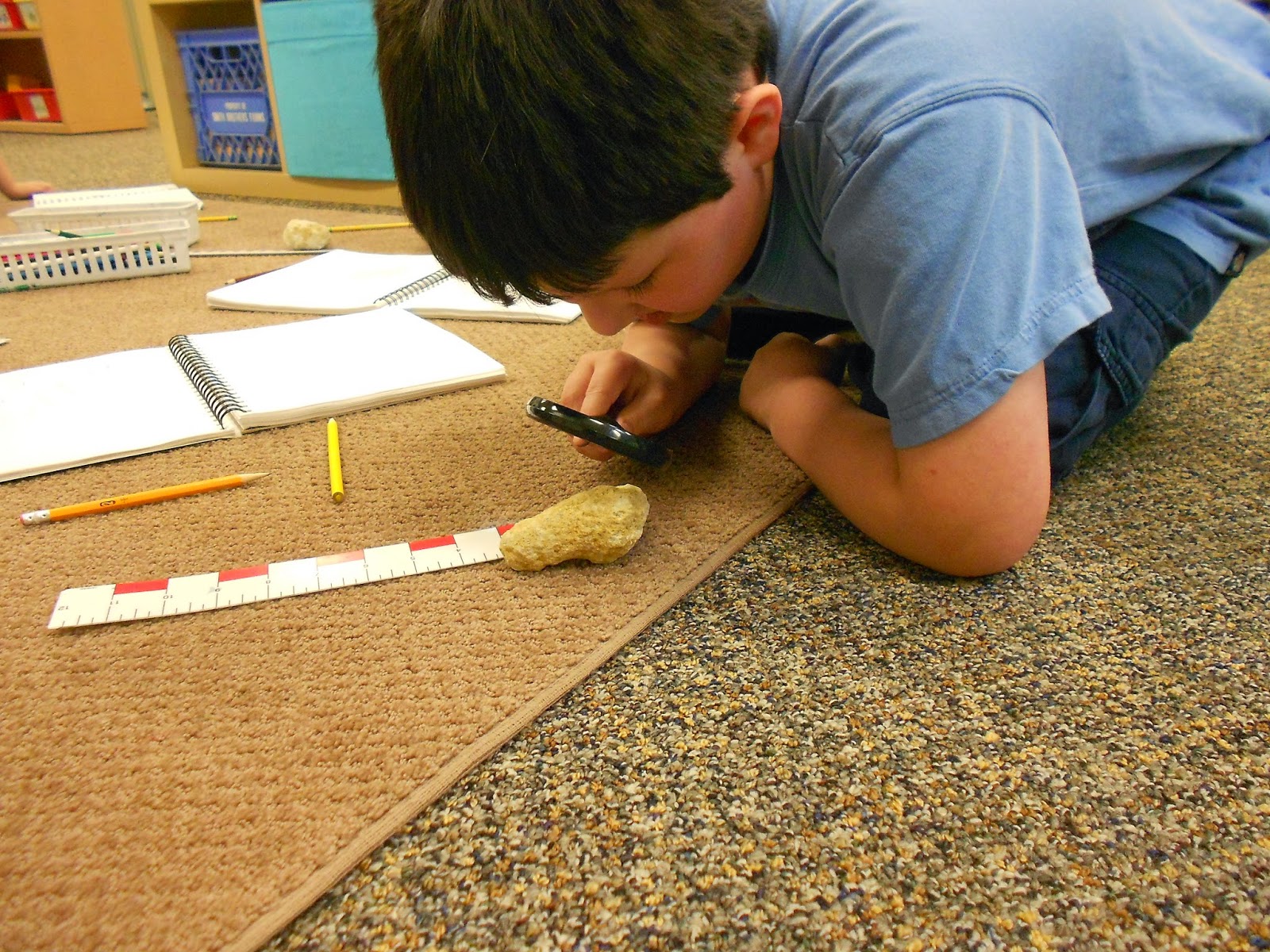
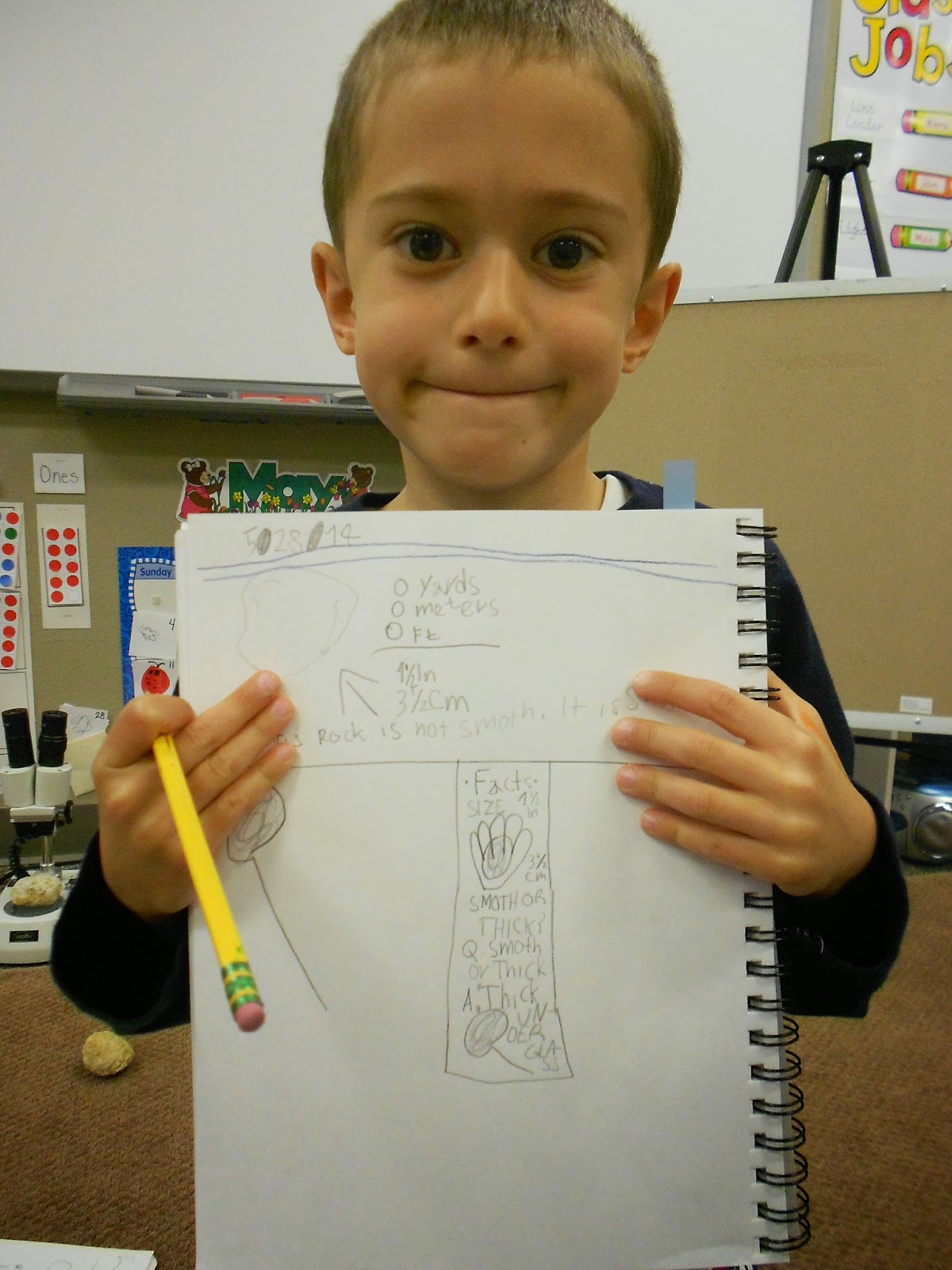
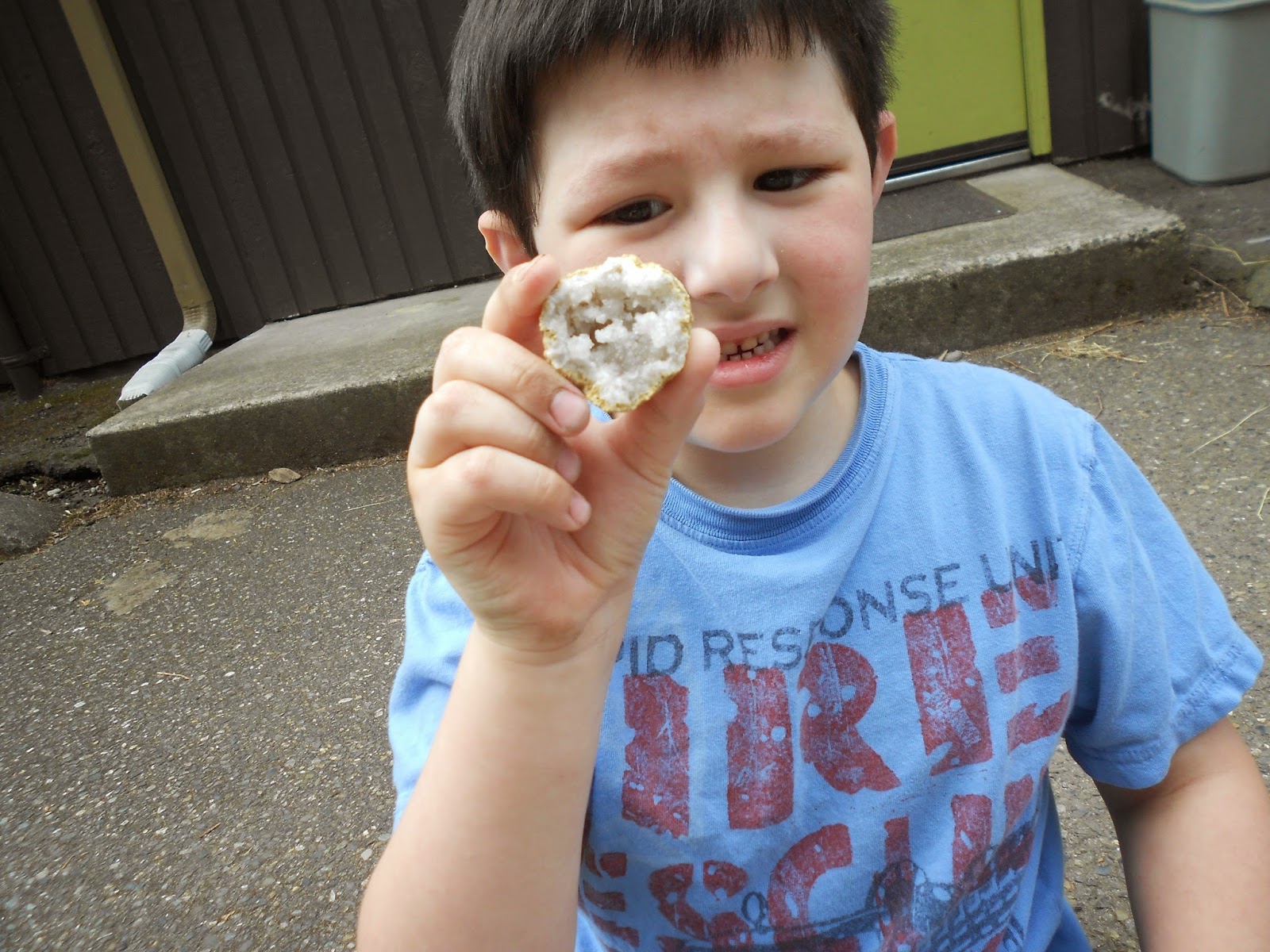
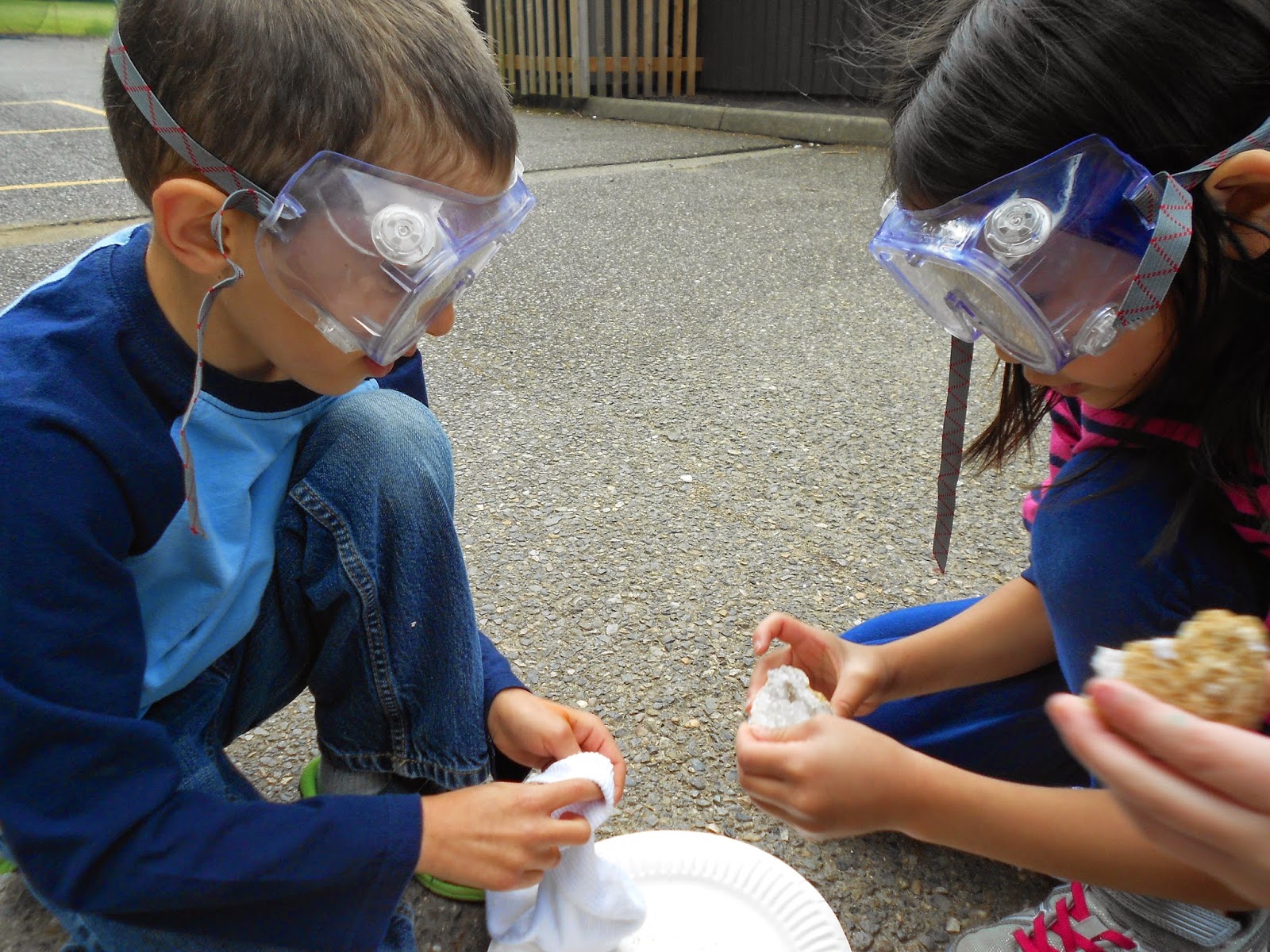
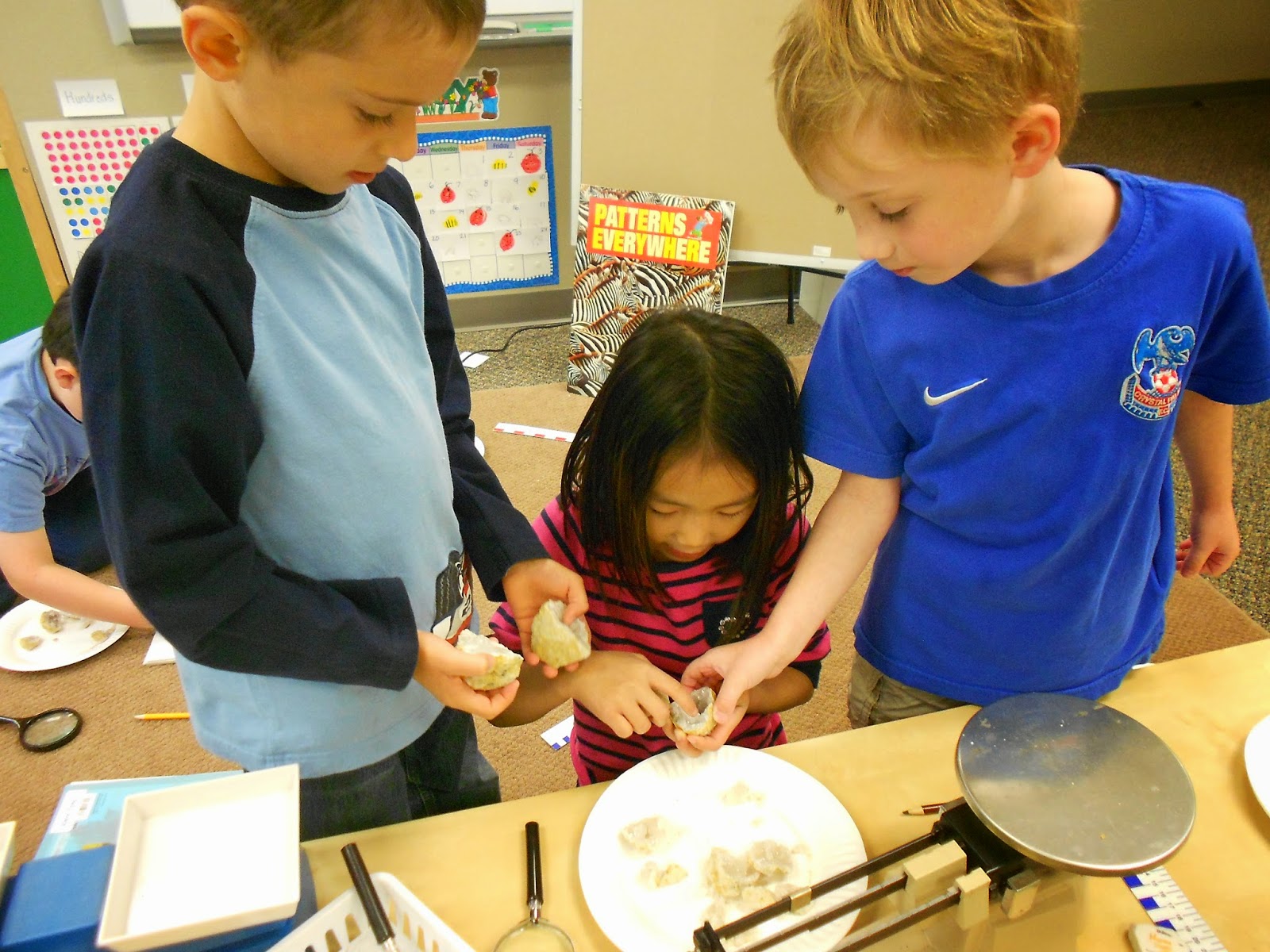
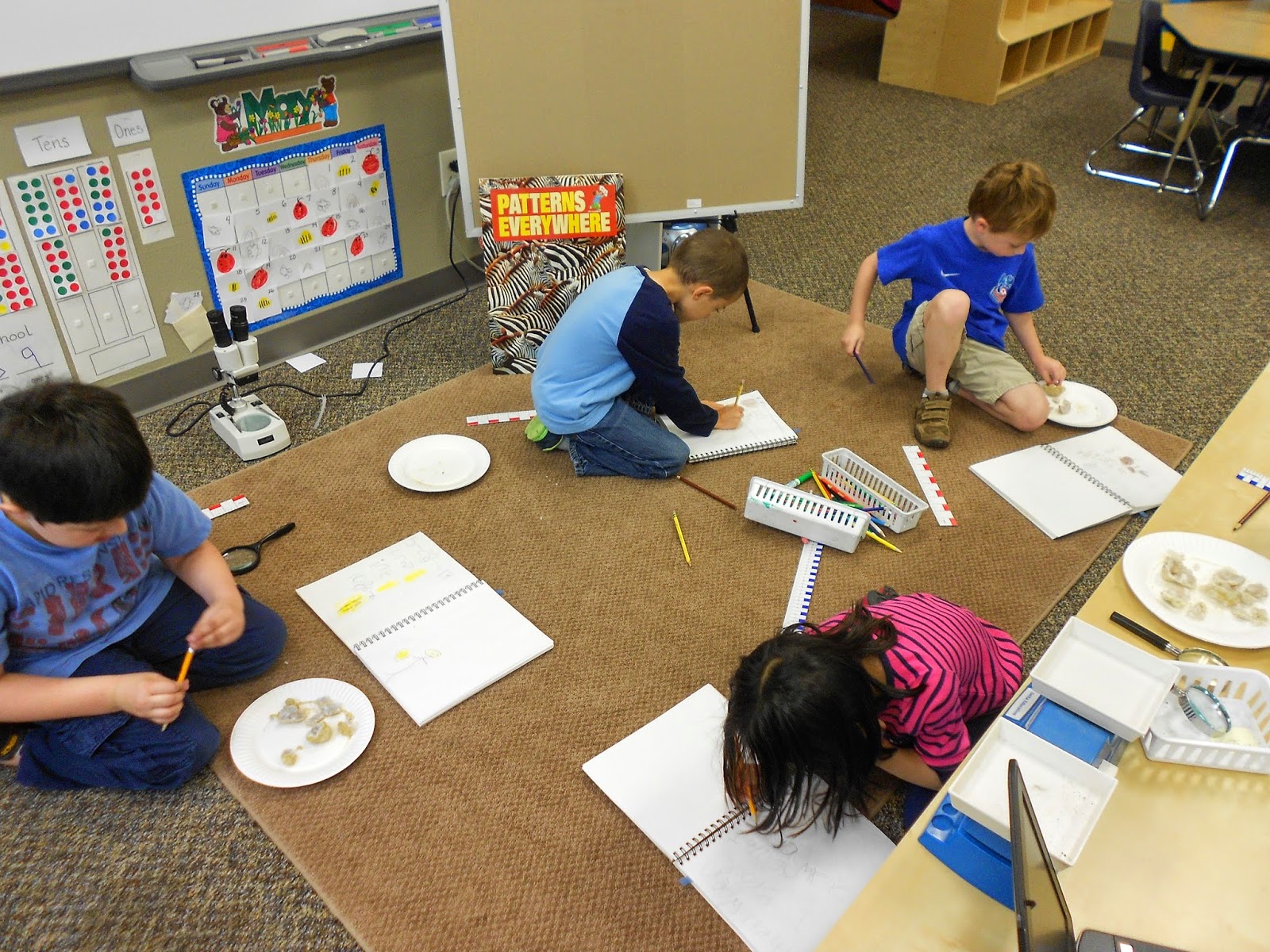
Today I gave the Bumblebees a geode that we bought from Jerry's Rock and Gem last week. They were so excited!!! First, in our science journals I had them measure, weigh, draw and describe their rock. They were very inquisitive, asking questions like, "How did the crystals form?, Why is there black spots on mine?, Do they come in different colors?" In the scientific method we were asking questions, forming hypothesis, collecting data and observing with pictures and words. Afterwards, I gave each kid a hammer (and safety goggles and a safety speech) and we hammered away. After a few whacks the geodes opened and they compared the insides. They noticed that some had bigger crystals and some were different shades. We concluded (with help from Google) that geodes are formed from gas bubbles when igneous (volcanic) rocks cooled. The slower the cooling, the bigger the crystals. Check their backpacks for their geode crystals.
| measuring with inches and centimeters |
| making observations and recording data in science journals |
| KF has broken apart the geode |
| look what is inside |
| comparing geodes |
| more comparing |
| science at work |
Thursday, May 15, 2014
Fraction Fun
Over the past few weeks I have introduced the concept of fractions. We played games with pizza slices, used pattern blocks and Cuisenaire rods, and even created art from fractional circle pieces. I was very impressed with how quickly the Bumblebees caught on; being able to identify and recreate fractional parts of a whole. Below are just a couple of the activities we have done.
| We used lots of fraction circles and pattern blocks to understand how parts of a whole together |
| We cut out fractions, learning that each piece doubled. |
| We can put different parts together to create a whole (intro to equivalent fractions) |
| We counted our shoes to see how to use fractions with a group of objects |
| The next three pictures were created with parts of a fraction circle |
Friday, April 18, 2014
Hamburger Analogy of Writing
| The Saguaro Cactus lives in the desert. It has ribs. The Saguaro Cactus lives 200 years. (to be finished.) |
Friday, April 11, 2014
Spring has Sprung!
I reflect back on these past 6 months, and think about how each Bumblebee started the year. I have observed so much growth, both academically and socially! This week the Bumblebees were so proud to have their own published book! We have shared them at Gathering, and they get to read them in the Author's Chair in the Library today. We have also started to study nature around us, using inquiry to guide our study. On Wednesday, I gave the group a box of seeds and had the explore them with the microscopes. Great questions came up, especially around the idea of why some seeds have umbrellas (dandelions), many are smooth, (beans, pumpkins), and while others "feel velcroy." I asked today what will be the first thing that happens to a planted seed. We have mixed hypotheses whether the stem or root will come out first. In addition, we are keeping lots of observable and measurable data, and will be introducing the concept of control and variable in later experiments.
Subscribe to:
Posts (Atom)